Follow the Dollar: What Your Morning Latte Actually Builds in Your Neighborhood
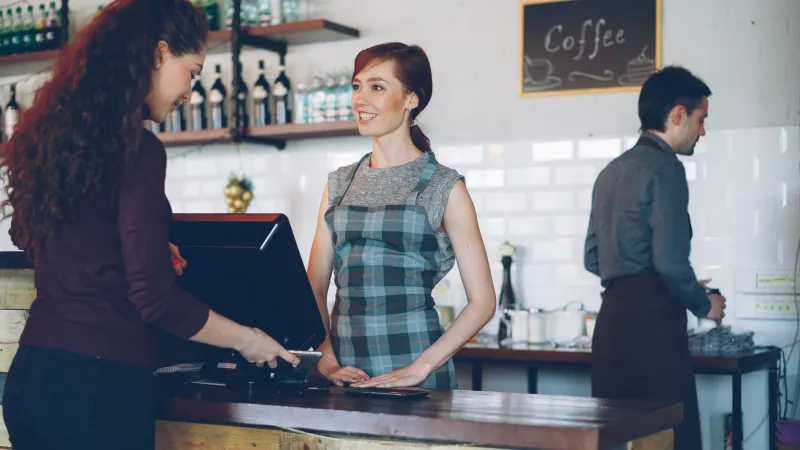
You hand over your card, grab your cup, and head out the door. Thirty seconds, maybe less. But that transaction — the one you've done so many times it barely registers — is quietly doing a lot of heavy lifting for the block you just walked away from.
Spending at an independent coffee shop isn't like buying something from a national chain. The economics work differently, and the effects ripple outward in ways that most customers never see. So let's slow it down and actually follow that dollar.
The Chain Reaction Nobody Talks About
Here's a number worth sitting with: according to research from the American Independent Business Alliance, locally owned businesses recirculate roughly 48 cents of every dollar back into the local economy. For chain businesses, that figure drops to about 14 cents. That's not a small gap. That's a fundamentally different economic relationship between a business and its neighborhood.
For a coffee shop specifically, the math plays out across several categories. There's the staff — typically the biggest line item for any café, and those wages get spent at nearby grocery stores, landlords, and restaurants. There are the suppliers: local bakeries dropping off pastries at 6 a.m., regional roasters whose livelihoods depend on wholesale accounts, dairy farms within driving distance that supply the milk steamed into your latte. And then there's the café owner herself, who probably lives nearby, shops locally, and reinvests in the business rather than sending profits to a corporate headquarters three states away.
All of that starts with you deciding to come back tomorrow.
Where the Money Actually Goes Inside a Café
Let's get specific about what a typical independent café's finances look like, because the breakdown is illuminating.
Labor usually runs somewhere between 35 and 40 percent of revenue. Rent takes another 10 to 15 percent, which means the landlord — often a local property owner — benefits directly from a thriving café tenant. Food and beverage costs account for roughly 25 to 35 percent, and this is where local sourcing decisions matter enormously. A café that buys its beans from a regional roaster, its muffins from a neighborhood bakery, and its eggs from a nearby farm is essentially functioning as a redistribution hub for local dollars.
What's left after those major costs — the thin margin that makes or breaks a small business — gets reinvested in equipment, repairs, marketing, and occasionally the kind of modest profit that allows an owner to stay in business another year. Independent café owners aren't getting rich. They're staying afloat, and their staying afloat matters.
The Invisible Anchor Effect
Real estate analysts have a term for businesses that stabilize foot traffic and make a commercial corridor more attractive: anchor tenants. Grocery stores and pharmacies are the obvious examples. But neighborhood cafés play a quieter version of the same role, and the effect on surrounding property values is measurable.
Studies on neighborhood revitalization consistently find that walkable, amenity-rich blocks — the kind with a coffee shop you'd actually want to spend time in — command higher residential rents and attract more retail investment. A beloved local café signals that a neighborhood is livable, that people gather there, that it's worth sticking around. That signal influences where people choose to live, where developers choose to build, and which other small businesses decide to open nearby.
In other words, your regular café habit is quietly making the case for your neighborhood's future.
Jobs That Actually Stay Local
Employment is another piece of this that gets overlooked. The coffee industry in the United States employs over 1.6 million people, a significant chunk of them in independent shops where jobs tend to be more stable and more community-connected than their chain counterparts.
A barista at a local café often knows the regulars, participates in neighborhood events, and has a stake in the place beyond a paycheck. Turnover is a real challenge in the industry, but shops that build genuine community tend to retain staff longer — and those employees, in turn, contribute to the neighborhood as residents, volunteers, and customers of other local businesses.
When an independent café closes, it doesn't just take the coffee with it. It takes those jobs, those relationships, and that economic circulation.
The Supplier Network You're Quietly Supporting
Pull back one more layer and you find the producers. Independent cafés are often the primary or exclusive wholesale customers for small regional roasters who couldn't survive on retail sales alone. They're the reason a local baker can justify the early morning hours. They create consistent demand for specialty dairy products that small farms depend on.
This is a web, not a line. And it's surprisingly fragile. When a neighborhood café loses enough customers to close, the roaster loses an account. The bakery loses a morning route. The farm loses a buyer. The disruption spreads outward in ways that never make headlines but absolutely affect people's livelihoods.
Your daily order is one thread in that web. It sounds like an overstatement until you realize how many threads it actually takes to hold something together.
What Regular Customers Are Actually Building
There's a word for what happens when a group of people consistently choose to spend their money in the same local place over time: investment. Not the financial instrument kind — the community kind. The kind that builds familiarity, trust, and resilience.
Regular customers are the economic backbone of any independent café. Not the occasional visitors, not the tourists who found the place on an app, but the people who show up on Tuesday mornings when it's raining and nothing particularly exciting is happening. Those people are the reason the lights stay on. They're also, in a very real sense, the reason the neighborhood stays the kind of place where a café like this can exist at all.
None of this requires a grand gesture. You don't have to become an activist or even think about economics when you walk in. You just have to keep coming back.
The Compounding Value of Showing Up
Economists talk about the multiplier effect — the idea that a dollar spent locally generates more than a dollar's worth of economic activity as it moves through a community. For independent businesses, that multiplier is real and meaningful. But it requires volume and consistency to work.
One customer showing up once doesn't move the needle. A hundred customers showing up every week for years? That's what keeps a small business solvent, what keeps a roaster in business, what keeps a neighborhood block from going dark.
So the next time you grab your usual, maybe let it register for just a second. Not as a political act or a civic duty — just as a fact. That cup of coffee is connected to something bigger than the cup. And you, just by being here, are part of what makes this corner of the neighborhood work.
We'll see you tomorrow.