Stop, Order, Breathe: The Two Minutes at the Counter That Can Actually Reset Your Whole Day
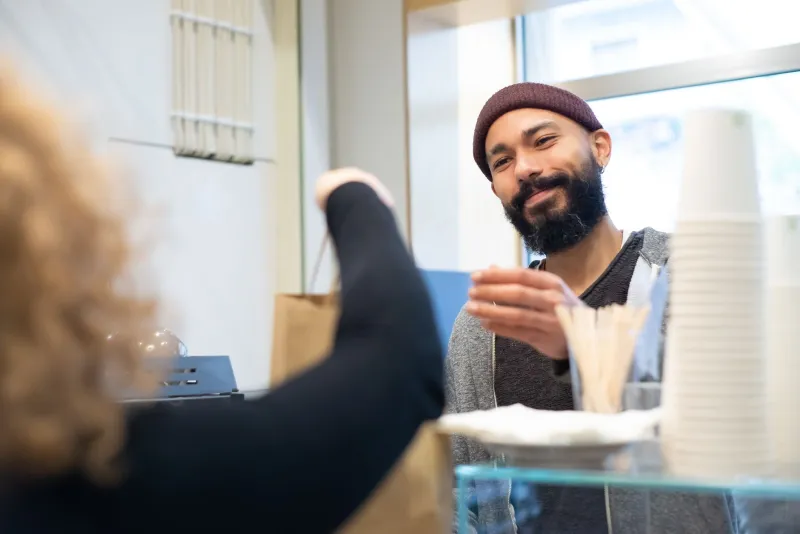
It takes about forty-five seconds to order a coffee through an app, pay with your phone, and grab your cup from the pickup counter without making eye contact with another human being.
Forty-five seconds. Efficient. Frictionless. Optimized.
Also, if we're being honest, kind of a bummer.
Not because technology is bad or convenience is evil, but because somewhere in the race to eliminate every small inefficiency from our mornings, we managed to strip out the part of the coffee shop experience that was quietly doing the most work — the ritual of actually ordering, waiting, and receiving a drink made by a person who, if you let them, might actually know your name.
What a Ritual Actually Does
The word "ritual" gets overused in wellness culture to the point where it can feel meaningless. But in psychology, it has a pretty specific meaning: a sequence of behaviors performed in a consistent order, often tied to a transition between mental states.
Rituals work because they signal to your brain that something is changing. Athletes use pre-performance rituals to shift from everyday mode into competition focus. Musicians have pre-show rituals. And whether you've thought about it this way or not, your morning coffee order — when you actually slow down and do it in person, at a counter, with a barista — functions as exactly this kind of transition marker.
Research on habit formation, including work from behavioral scientists like Wendy Wood at USC, consistently shows that environmental cues and routine sequences are among the most powerful triggers for mental state changes. The walk to the café, the smell of espresso, the familiar greeting from someone behind the counter — these aren't incidental. They're the mechanism.
When you skip all of that in favor of a tapped app order and a silent pickup, you're not just saving time. You're removing the transition.
The Grab-and-Go Trap
America has been very good at optimizing coffee for speed. Drive-throughs, mobile ordering, instant pickup lanes — every major chain has invested heavily in making the coffee transaction as fast and frictionless as possible. And independent cafés, facing pressure to compete, have followed suit.
There's nothing wrong with efficiency when you genuinely need it. But there's a cost to defaulting to maximum speed every single day, even when you don't actually need to rush.
"I had a customer who came in every morning and always mobile-ordered ahead," said a barista at an independent café in Nashville. "One day the app was down and she had to order at the counter. We ended up talking for like three minutes while I made her drink. She told me later it was the best she'd felt all week. She started coming in early enough to order in person after that."
That story sounds small. But it points at something real about what we lose when we treat every interaction as something to be optimized away.
The Pause Is the Point
Here's what actually happens when you slow down your café order — when you walk up to the counter without having pre-submitted your request, make eye contact, and take a moment to decide.
First, there's a brief interruption to whatever you were mentally chewing on during your commute or your morning scroll. Psychologists call this a "pattern interrupt" — a small break in the cognitive loop that gives your brain a moment to reset.
Second, you engage in a low-stakes social interaction. This sounds trivial, but research consistently shows that brief, positive exchanges with strangers — what sociologists call "weak tie" interactions — are associated with higher daily wellbeing. Your barista isn't your best friend, but that doesn't mean the exchange is meaningless. It's actually doing something.
Third, you wait. And in the waiting, something interesting happens if you let it: you're present. Not scrolling, not planning, not half-listening to a podcast. Just standing in a warm room that smells like coffee, watching something be made for you. That's a form of mindfulness that doesn't require a meditation app.
"I started leaving my phone in my bag when I'm in line," said Priya, a project manager in Seattle. "It felt weird at first. Now it's the only part of my morning where I'm not consuming anything. I just... stand there. And I always feel better when I sit down with my coffee than I did when I walked in."
The Art of Actually Ordering
There's a version of slowing down your café order that doesn't require a personality transplant or a significant time investment. It just requires a small intention shift.
Try this: before you walk through the door, put your phone away. When you get to the counter, take a breath and actually look at the menu — even if you already know what you want. Let yourself be a person in a moment, not a transaction moving through a queue.
When the barista asks how you're doing, give them a real answer. Not a novel — a sentence is fine. But something true. "Tired, honestly, but glad to be here" beats "good, thanks" as a human exchange by a significant margin.
If you have twenty extra seconds, ask about the seasonal special. Or tell them something smells amazing. Or just make eye contact and smile like you mean it.
None of this is revolutionary. It's just being a person.
Anticipation Is Underrated
There's one more thing worth mentioning: the wait itself.
Behavioral economists have documented what they call the "anticipatory pleasure" effect — the idea that looking forward to something generates genuine positive emotion, sometimes as much as the thing itself. Waiting for your name to be called, watching your drink being made, hearing the sound of the espresso machine — that's not dead time. That's your brain doing something it actually enjoys.
Grab-and-go culture has decided that anticipation is friction to be eliminated. But if you're already at the café — if you've already made the choice to be there — why race through the best part?
Two Minutes That Belong to You
The average café transaction, done in person and without rushing, takes somewhere between two and four minutes. That's it. That's the whole ritual.
Two to four minutes of walking up, ordering, waiting, receiving, and exchanging a few words with someone who is genuinely glad you came in. Two to four minutes of being somewhere warm, smelling something good, and not being asked to do anything except decide what you want.
In a day that will ask a lot of you, that's not nothing. That's actually quite a bit.
The coffee will taste the same whether you ordered it on an app or at the counter. But the morning won't feel the same. And after enough mornings, that difference adds up to something you might not even notice you've been missing until you slow down long enough to find it again.