Plugged In, Tuned Out: What Happens to a Café's Soul When Everyone's on a Deadline
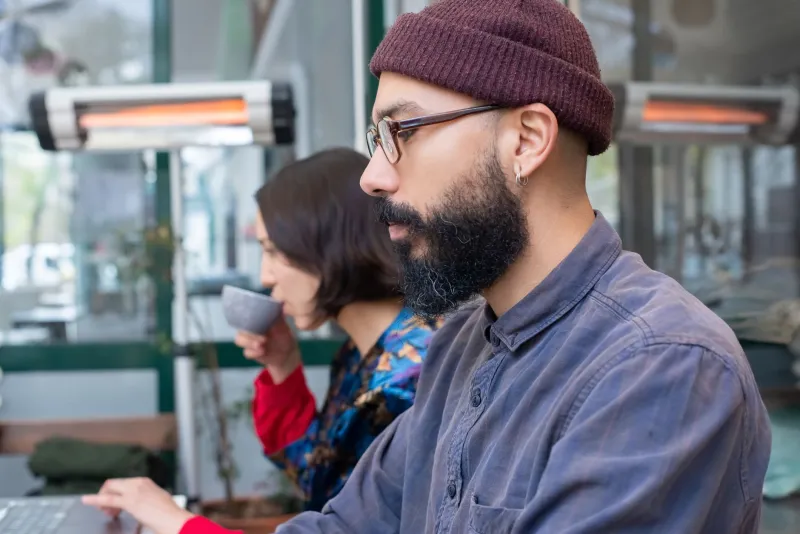
There's a particular kind of silence that settles over a coffee shop around 10 on a Tuesday morning. Not the comfortable, unhurried quiet of a slow weekend — something tighter than that. Heads down. Earbuds in. Screens glowing. A dozen people in the same room, and not one of them is really there.
If you've spent any real time in your local café over the past few years, you've felt it. The vibe has changed. The rhythm is different. And depending on who you ask, that's either totally fine or a quiet kind of loss.
How the Coffee Shop Became America's Unofficial Co-Working Space
It didn't happen overnight. Long before the pandemic reshuffled everyone's work arrangements, laptops had already been creeping into cafés. Writers, freelancers, students — the coffee shop as workspace has always existed in some form. But the scale has shifted dramatically.
According to a 2023 survey by Owl Labs, nearly 30% of American workers operate in some kind of hybrid or fully remote arrangement. A chunk of those people need somewhere to go that isn't home — somewhere with decent Wi-Fi, ambient noise, and an endless supply of caffeine. The café checks every box.
For coffee shops, especially independent ones, this has been a genuinely complicated development. On one hand, a laptop worker nursing a single oat milk latte for three hours is a paying customer. On the other hand, that same person is occupying a four-top during peak hours, headphones on, completely unavailable to the kind of spontaneous conversation that used to define the space.
What Baristas Are Actually Seeing
Ask anyone who's worked behind an espresso machine in the last five years, and they'll tell you the shift is real and visible.
"It used to be that you'd have people come in, get their coffee, and actually talk to each other," says one barista at a neighborhood café in Austin, Texas, who's been pulling shots for going on seven years. "Now I'll have the same faces in here every single day, and they've never once spoken to the person sitting next to them. They're here, but they're not here, you know?"
That distinction — physically present versus actually present — is at the heart of what regulars and café owners are wrestling with. The third place concept, popularized by sociologist Ray Oldenburg, describes spaces that exist outside home and work: the barbershop, the local bar, the diner, the café. The defining feature of a genuine third place isn't the product being sold. It's the social texture. The loose, unscripted interaction between people who might not otherwise cross paths.
When the café becomes an extension of the office, that texture starts to fray.
The Regulars Who Remember It Differently
Longtime café patrons tend to describe the old rhythm with a kind of wistfulness — not nostalgia exactly, but something adjacent to it.
"I used to come in here and end up in a conversation with someone completely random," says a retired teacher in her late sixties who's been coming to the same Denver café for over a decade. "A guy writing a novel. A woman who just moved here from Portland. You'd just talk. Now everyone's got their bubble up, and you feel rude if you try to pop it."
That bubble — the invisible wall of headphones and open laptops — communicates something clear: I am working. Do not disturb. Which is a perfectly reasonable thing to communicate in an actual office. In a café, it rewrites the social contract entirely.
The irony is thick: people often choose to work from coffee shops because of the ambient energy, the background hum of community. But by collectively retreating into their screens, they're slowly draining the very atmosphere they came to absorb.
Where Café Owners Are Drawing the Line
Some independent shops have started pushing back — gently, and with varying degrees of success.
No-laptop hours during peak times. Seating sections designated as screen-free. A quiet policy that isn't about noise but about presence — asking people to actually be in the room, at least for a little while. A café in Portland made waves a couple of years ago by removing all its electrical outlets and watching, with cautious optimism, as conversation slowly returned.
Others have leaned into the co-working model entirely, adding dedicated workspace sections, faster Wi-Fi, and monthly memberships. It's a pragmatic response to economic reality — and it works, financially. But it also accelerates the transformation, turning the café into something closer to a WeWork with better espresso.
There's no universally right answer here. An independent café that alienates remote workers risks losing revenue it can't afford to give up. A café that fully embraces the office-away-from-office model risks becoming something that no longer needs the word community in its mission statement.
The Paradox Nobody Talks About Out Loud
Here's the thing that makes this genuinely complicated: most remote workers who set up shop at their local café aren't trying to ruin anything. They love the place. That's why they're there.
They want the warmth of the room, the smell of fresh-ground coffee, the low hum of other human beings going about their lives. They're drawn to the community — they just aren't always contributing to it. And that gap, between drawing from a space and giving back to it, is where the tension lives.
The café that feels like home when you wander in on a Saturday afternoon can start to feel like a shared office building when you're parked there with a deadline and a second cold brew. The magic doesn't disappear — it just gets harder to find under all the open tabs.
Finding the Balance — and Why It Matters
The coffee shops navigating this best seem to share one thing in common: they're intentional about it. They think about the rhythm of their space the way a host thinks about the rhythm of a dinner party. When do people need room to breathe? When does the energy need a nudge?
That might mean a barista who actually chats with the regulars instead of just processing orders. A community board that changes often enough to give people a reason to look up. Events — open mics, book swaps, local artist nights — that remind everyone the room has a pulse.
Because here's what's worth protecting: the accidental conversation. The moment a stranger recommends a book and you end up talking for forty-five minutes. The way a café can make you feel less alone in a city where loneliness is quietly epidemic.
Your laptop is welcome here. Your deadline is understandable. But every once in a while, close the screen. Take out one earbud. Let the room back in.
That's what the coffee shop was always for.