Sip by Sip: How America Fell in Love with Seriously Good Coffee
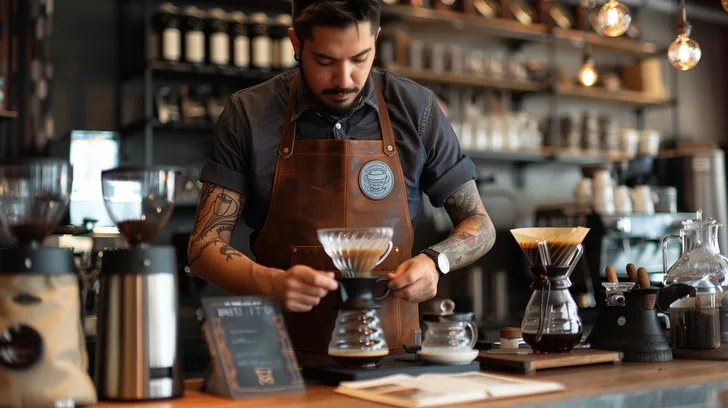
Photo: barista pouring pour-over coffee in cozy neighborhood cafe, via images.stockcake.com
There's a moment that a lot of coffee drinkers remember. It's the first time someone handed them a cup that actually tasted like something — like blueberries, or dark chocolate, or a campfire on a cool morning. Not like hot brown water. Not like the stuff from the machine in the break room. Something real.
That moment, multiplied across millions of Americans, is basically the story of how specialty coffee went from a quirky hobby to a full-blown cultural movement. And if you've ever pulled up a stool at a neighborhood café and watched a barista carefully pour hot water in slow, deliberate circles over a bed of freshly ground beans, you've witnessed that movement in action.
From Instant to Intentional
Let's rewind. For most of the 20th century, coffee in America was about convenience. Folgers. Maxwell House. The percolator on the stovetop. These weren't bad things — they were practical, affordable, and deeply woven into the fabric of American domestic life. Instant coffee had its moment too, especially after World War II, when soldiers came home with a taste for the stuff they'd been drinking overseas.
The first real shake-up came in the 1970s and '80s, when Peet's Coffee out of Berkeley, California started treating beans like something worth caring about. A young Howard Schultz took notice, and Starbucks eventually brought the idea of espresso drinks to the American mainstream in a big, green-logo way. That was the second wave — coffee as a lifestyle product, coffee with foam art, coffee with a sixteen-syllable order.
But somewhere in the late '90s and early 2000s, a quieter revolution was already brewing. Small roasters in Portland, Brooklyn, Nashville, and Chicago started asking harder questions. Where were these beans actually grown? Who picked them? What happens to flavor when you roast light versus dark? The third wave wasn't just about drinking better coffee — it was about understanding it.
The Pour-Over Changes Everything
Nothing symbolizes the shift quite like the pour-over. It's almost comically simple: a filter, a cone, some hot water, and patience. No pods. No pressure. Just gravity doing its thing while you pay attention.
The pour-over forced American coffee drinkers to slow down, and that slowness turned out to be the whole point. When you make coffee that way — or when you watch a skilled barista do it — you start noticing things. The bloom of the grounds as the first water hits them. The way the color of the brew changes as the extraction deepens. The aroma that fills the room before you've even taken a sip.
It's not about being pretentious. It's about being present. And that's a pretty radical thing to ask of a culture that spent decades optimizing for speed.
Your Neighborhood Café as a Living Lab
Here at The Java Café, we think about this stuff a lot. Our baristas aren't just pulling shots — they're making decisions. Which roast works best this week? Is the grind a little coarse? Does this single-origin Ethiopian bean need a slightly lower water temperature to bring out those bright, citrusy notes?
That level of care doesn't happen in a vacuum. It happens because people ask questions. Regulars who started coming in for a basic latte and now have opinions about processing methods. First-timers who point at the pour-over station and say, "Wait, what is that?" Curious kids who want to know why coffee smells so different from how it tastes.
Neighborhood cafés like ours have become informal classrooms for coffee literacy. Not in a gatekeeping, you-must-know-the-jargon kind of way — but in the best possible sense, where knowledge is shared over a counter by someone who genuinely loves what they do.
The Roaster's Perspective
Talk to any small-batch roaster and they'll tell you the same thing: the relationship between the café and the customer is what closes the loop. Farmers in Ethiopia or Colombia or Guatemala put extraordinary care into their crops. Roasters obsess over time and temperature curves. But if the person drinking the coffee has no context for any of that, something gets lost.
Cafés are where that context gets built. A good barista can bridge the gap between a remote farm and a Tuesday morning in your neighborhood. They can tell you why this bag of beans costs what it costs, and make you feel like that price makes sense — because it does.
The third-wave movement has also pushed the industry toward more ethical sourcing. Direct trade relationships, transparency about farm conditions, fair wages for producers — these aren't just marketing buzzwords anymore. They're standards that coffee-literate consumers are starting to expect. And that expectation grew, in large part, because cafés started telling the story behind the cup.
What's Next for American Coffee Culture?
The movement keeps evolving. Canned and bottled cold brew has exploded. Oat milk has become a staple rather than a novelty. Whole new categories — adaptogen lattes, mushroom coffee, ultra-light roasts that taste almost like tea — are finding their audiences. The definition of "good coffee" keeps expanding.
But here's what hasn't changed: people still want a place to go. A counter to sit at. A familiar face who remembers how you take yours. No app or subscription box has figured out how to replicate the feeling of walking into your regular spot and being known.
That's the thing about the third-wave coffee movement that gets undersold. Yes, it's about better beans and better technique. But it's also about reclaiming the ritual of coffee — making it meaningful again, one carefully poured cup at a time.
And honestly? That's exactly why we're here. Pull up a chair. We just got a new single-origin in from Oaxaca that we think you're going to love.